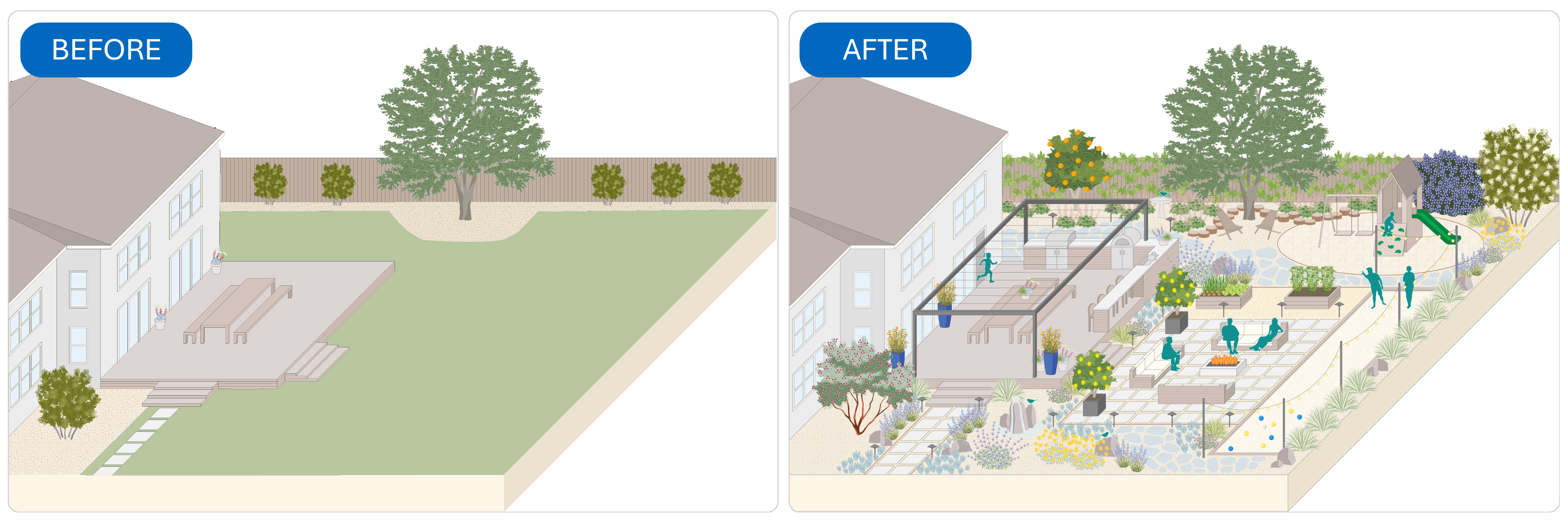
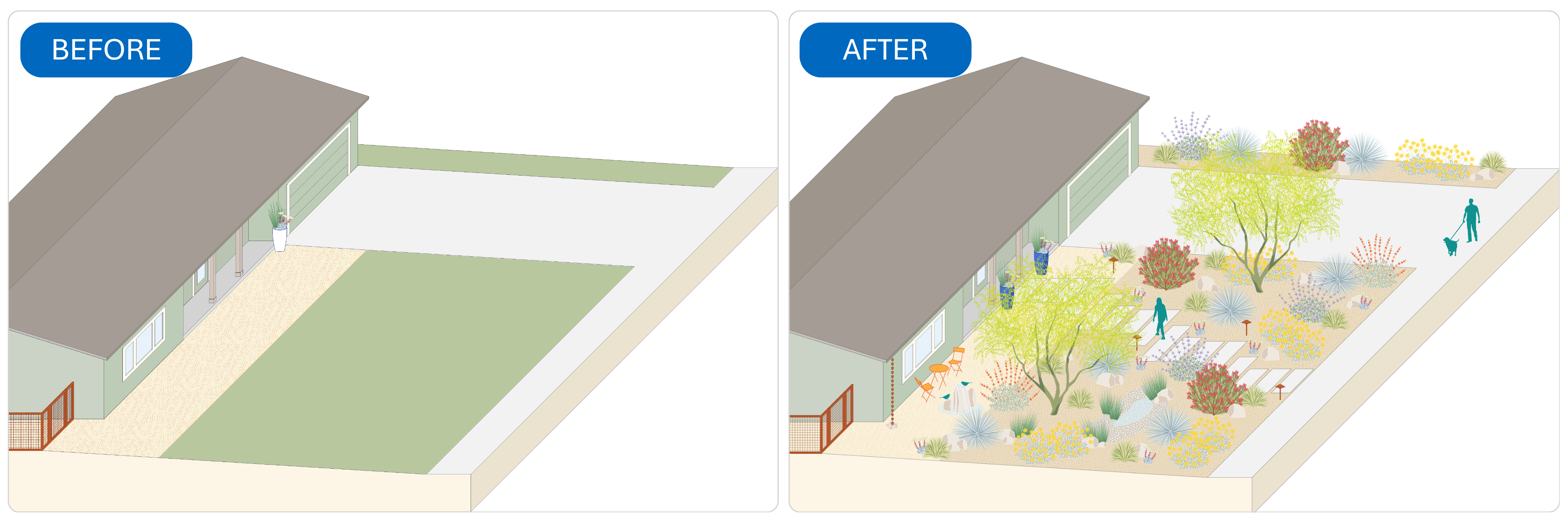
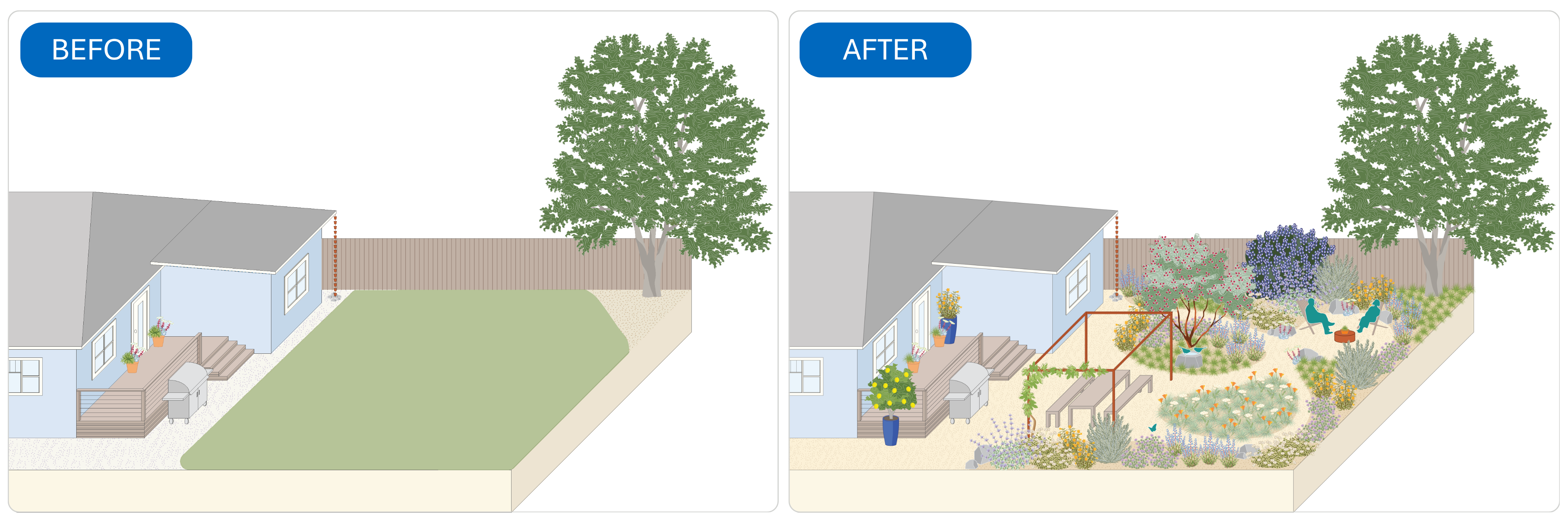
What is the Lawn Conversion Rebate?
The Lawn Conversion Rebate provides a rebate for converting your lawn to a waterwise landscape. Choose an option below that best fits your project goals.
Standard Rebate
Rebate: $1.00 per sq. ft.
Convert your high-water lawn to a beautiful, resilient, waterwise garden.

- Remove the lawn.
- Install low-water plants.
- Add 3 inches of mulch.
- Convert to drip irrigation, high-efficiency nozzles, or hand water.
Plants
- Plants must cover 50% of the converted area once fully grown. Seeded plants do not count toward plant coverage. Including a tree is recommended (Treebate available!).
- Plants must be low-water-use. Check plant water use at: WUCOLS Plant Database.
- All edible plants are accepted for Standard Rebate projects, while only low-water-use edible plants are accepted for Super Rebate projects.
- Artificial turf, invasive plants, and lawn-like grasses are not allowed.
Materials
- Planted areas and exposed soil must be covered with at least 3 inches of mulch.
- New pathways or patios must be permeable, allowing water to pass through (e.g., pavers set in sand, gravel, or decomposed granite).
- Landscape fabric and weed cloth are not allowed. Only cardboard or paper may be used.
Irrigation
- Existing sprinklers must be removed, capped, or replaced with a drip system or high-efficiency nozzles.
- If installed, drip systems must include a pressure regulator and filter.
- Plants with different water needs must be placed on separate irrigation zones.
*See the online application for complete eligibility requirements.
Super Rebate
Rebate: $2.00 per sq. ft.
Follow these additional ecological best practices to receive double the Standard Rebate.
- Sheet mulch by leaving the lawn in place and adding a layer of cardboard, compost, and mulch on top of it.
- Choose a majority of plants native to California.
- Install plants during the cool season (September–February).
Additional Super Rebate requirements:
-
Sheet mulch instead of removing lawn. Leave the lawn in place and cover it with a layer of cardboard, compost, and mulch. See lawntogarden.org for guidance. No herbicides or other chemicals may be used to remove the lawn.
-
Install a majority of California native plants. Search on calscape.org to find native plants for your project.
-
All plants must be installed between September and February to take advantage of cool, rainy weather for plant establishment.
Complete the above in addition to the Standard Rebate requirements below:
Plants
- Plants must cover 50% of the converted area once fully grown. Seeded plants do not count toward plant coverage. Including a tree is recommended (Treebate available!).
- Plants must be low-water-use. Check plant water use at: WUCOLS Plant Database.
- All edible plants are accepted for Standard Rebate projects, while only low-water-use edible plants are accepted for Super Rebate projects.
- Artificial turf, invasive plants, and lawn-like grasses are not allowed.
Materials
- Planted areas and exposed soil must be covered with at least 3 inches of mulch.
- New pathways or patios must be permeable, allowing water to pass through (e.g., pavers set in sand, gravel, or decomposed granite).
- Landscape fabric and weed cloth are not allowed. Only cardboard or paper may be used.
Irrigation
- Existing sprinklers must be removed, capped, or replaced with a drip system or high-efficiency nozzles.
- If installed, drip systems must include a pressure regulator and filter.
- Plants with different water needs must be placed on separate irrigation zones.
*See the online application for complete eligibility requirements.
Commercial Median Strip Rebate
Rebate: $2.00 per sq. ft.
It's nearly impossible to irrigate lawn median strips efficiently, so we're offering double our Standard Rebate to convert these lawn strips to waterwise plants and efficient irrigation.
- Offer available to commercial customers only for qualifying median strips.
- All Standard Rebate requirements apply.
Rebate maximums
All rebates are subject to the following maximums within a 2-year period:
- $2,000 for single-family and small multi-family homes
- $15,000 for commercial, municipal, and large multi-family properties (5+ units)
Eligibility requirements
- Lawn has been irrigated with potable EBMUD water and actively maintained (mowed) for at least the past 3 years.
-
Project has not started and will not begin until EBMUD provides notice of approval.
How EBMUD confirms eligibility
- The property's water use history must show higher water use during the summer than in the winter, indicating seasonal irrigation.
-
Historical satellite imagery must show a green, maintained lawn during the summer months.
Prohibited installations
If you install the following, your project will not be eligible:
- Artificial turf
- Sod grass, including "no-mow" grass
- Plants listed as invasive on cal-ipc.org
- Concrete, mortared, or glued paths or patios
- Landscape fabric or weed cloth
- Microspray or adjustable emitters/bubblers
How to apply
Review the steps below and refer to the Rebate Requirements and Documentation for details on each rebate type, including requirements and required photos, screenshots, and receipts needed to complete a rebate project.
Step 1: Apply online.
Submit your application before beginning your project. If you need assistance filling out your rebate application, email us at waterconservation@ebmud.com.
Step 2: Wait for approval.
Wait for EBMUD approval before beginning any work on your project.
Step 3: Complete your project within 9 months.
After receiving EBMUD approval, complete your lawn conversion and provide all required documentation (sample here) within the 9-month deadline.
Step 4: Receive your rebate.
After you submit all requested information and your rebate is approved, the rebate will be issued as a check within two months. Rebates of $2,000 or more in a single tax year require a W-9 form.
Resources for a successful project
- Rebate Requirements and Documentation: Detailed list of requirements, required photos, screenshots, and receipts needed to complete a rebate project.
- Lawn-to-Garden Design Center: Step-by-step resources on how to plan your lawn conversion project.
- WaterSmart Gardener: Tools and resources to help you create a water-efficient landscape.
- StopWaste Lawn to Garden: Sheet mulching tutorials and a materials marketplace.
- Low-Water Plants: Plant resources and search tools to create a waterwise plant list for your project.
- Rebate Eligibility Plant Database: Check to see if a specific plant is eligible for a rebate project.
- Rebate Virtual Office Hours: Virtual drop-in sessions over Zoom to ask questions about rebate projects, offered every 1st and 3rd Tuesday from 12 - 1 p.m.
Frequently asked questions
No. To be eligible, the lawn must have been in place and irrigated with EBMUD potable water for at least the past three years. EBMUD will review the property's water use history and satellite imagery to confirm that the lawn was green, maintained, and actively irrigated during summer months.
If your lawn does not meet these requirements, you may qualify for other rebates to support your project, including the Design Assistance Rebate or Spray to Drip Conversion Rebate.
Use the questions below to see which rebate may be right for your project:
-
Question 1: Can you install your plants between September and February?
-
Yes → Continue to Question 2.
-
No → You will need to apply for a Standard Rebate. The Super Rebate requires planting during the cool, rainy season to help establish plants with less supplemental irrigation.
-
-
Question 2: Can you sheet mulch (apply a layer of cardboard, compost, and mulch) over your existing lawn, without using herbicides?
-
Yes → Continue to Question 3.
-
No → If you need to physically remove your lawn for any reason, including using herbicides, you will need to apply for a Standard Rebate. Super Rebate projects require the lawn to remain in place and be sheet mulched over top using a layer of cardboard, compost, and plant-based mulch.
-
-
Question 3: Are you planning to use a majority of California native plants?
-
Yes → If you answered yes to all three questions, you may apply for a Super Rebate.
-
No → You will need to apply for a Standard Rebate if you do not use a majority of plants native to California.
-
Yes. Super Rebate applications are accepted year-round, so you do not need to wait until September to apply.
The 9-month project deadline allows enough time to meet the planting window requirement regardless of when your application is submitted. We encourage applying early so you can get a head start on preparing for fall or winter planting.
You may complete other aspects of your project outside the September–February planting window, such as sheet mulching or irrigation installation. Only the planting must occur between September and February to qualify for the Super Rebate.
The Super Rebate offers twice the rebate amount for lawn conversion projects that meet additional water conservation and environmental criteria.
Why is EBMUD encouraging these practices?
-
Sheet mulching: Layering cardboard, compost, and mulch, over existing grass allows the lawn to decompose in place, which can improve soil quality and reduce landfill waste.
-
California native plants: Native plants are adapted to our dry summers, support local wildlife, and increase biodiversity. Once established, many California native plants need minimal supplemental irrigation beyond normal rainfall.
-
Fall and winter planting: Planting during the cool, rainy season allows new plants to use natural rainfall for establishment, reducing the need for supplemental irrigation.
No, the lawn conversion rebate program is intended to incentivize the conversion of existing lawns and is not retroactive. Projects that have been started or completed (including removing the lawn) without formal EBMUD approval are not eligible.
No. While artificial turf may require less water compared to a traditional grass lawn, EBMUD does not rebate it due to environmental considerations such as plastic leaching, lack of viable recycling options, and the urban heat island effect. For more information, please see Valley Water's Artificial Turf Information Sheet.
Lawn conversion rebate projects are given a 9-month deadline to complete the project after EBMUD application approval.
If you cannot meet your project deadline please reach out to the staff member who approved your application before your deadline passes. Extensions may be granted on a case-by-case basis, but are not guaranteed.
Our rebate programs have expiration dates to allow us to make modifications as needed. Unless designated as a pilot on our website, most of our rebate programs will continue beyond the expiration date listed on the application.
During any 24-month period, the combined rebate amount provided by EBMUD may not exceed $2,000 for residential and small multi-family properties (4 units or less), and $15,000 for commercial and large multi-family properties (5+ units). You may apply for an additional rebate after the 24-month period has elapsed.
For customers who apply for rebates that, individually or in combination total $2,000 or more in a tax year, EBMUD requires the submittal of a W-9 form from the person/entity receiving the payment prior to payment. All personal information provided within the W-9 will be kept confidential in accordance with the Consumer Privacy Act and other applicable state and federal law.
If the total rebate amounts received are $2,000 or more in a single calendar year, a 1099 form will be issued in accordance with Federal Internal Revenue Service requirements. Most rebates are excluded from gross income by state law and are not subject to state income tax, but these rebates may be taxable income under federal law. The determination of whether the rebate may be subject to federal or state tax is dependent on several variables, and it is recommended that you contact a tax professional for further information.