Save water, improve plant health, and lower watering costs by using these irrigation tips for HOA common areas, business parks, and other commercial landscapes.
With the irrigation controller (if present) in the winter "off" position, check the meter. Is the flow indicator (usually a blue circle or red triangle on the meter dial face) spinning?
If yes, turn off the backflow. If the flow indicator is still spinning, there is a leak between the backflow and the meter
In this case, work with a leak detection company to determine the exact location of the leak to minimize any needed trenching
If, once the backflow is off, the flow indicator is not spinning, you have a leak in the pressurized main lines
If the flow indicator on the meter is NOT spinning when the controller is in the "off" position, the leak could be occurring during the run times of the zones. Test zones one by one to narrow down where excessive flow may be happening.
Tip 2. Create irrigation controller maps
Irrigation controller maps delineate what landscape area is controlled by what valve. Maps should indicate the type of irrigation (spray, rotor, drip, or bubblers). Keep a copy in the controller, and store backup copies digitally.
Tip 3. Inspect irrigation system
Perform an irrigation inspection to check for common issues such as:
Broken/misdirected sprinklers
Clogged or leaking drip irrigation
Leaking or stuck irrigation valves
Assess any unaddressed environmental factors
Bioswales need to be closely monitored for clogged inlets/overflows, substrate condition and plant health
Whether you are working with a conventional (non-smart) or smart (sensor or weather based to adjust run times based on local conditions) controller, it is important to review and update the settings seasonally as plants mature and the landscape changes.
Every system and every landscape is unique and therefore may need more or less than what is suggested. Start with our lawn and landscape watering guide as a reference.
Ensure that the controller(s) on site are adjusted monthly to meet changing seasonal irrigation demands
Microclimates - plants growing in shady areas (north/east side) will generally require 50% less water than the same plants in full sun. Create programs for different types of plants. For example, lawn and trees should be on separate programs.
Schedule irrigation cycles to water deeply and less frequently to encourage healthier plants and better able to withstand drought.
Multiple starts - Minimizes irrigation run-off by applying water at a rate the soil can accept, and keeps water at the root zone. Instead of one long cycle per night, set it to water three shorter cycles overnight.
Create a base schedule. The amount you water is set as a fixed setting (minutes, starts per day, and program number), determined by plant water needs and the type of sprinkler (spray, rotor, drip, etc.). Adjust for seasonal changes by adding or deleting water days or by using the % adjustment feature, using 100% for July, adjusting down through August and September (70%-90%), and removing watering days by October.
Water Budget Feature (% button) - Quickly adjusts sprinkler run times only (+/-) during the irrigation season, reducing irrigation later in the summer when plant water needs begin to decrease.
If you have a conventional controller, record your irrigation schedule and keep it with your controller or save a photo on your phone. This way you will always know how long and how often each valve or station runs.
Tip 5. Use a smart irrigation controller
Smart controllers use programming information (such as plant type, soil type, and irrigation equipment type) combined with local weather data to automatically adjust irrigation run times and schedules.
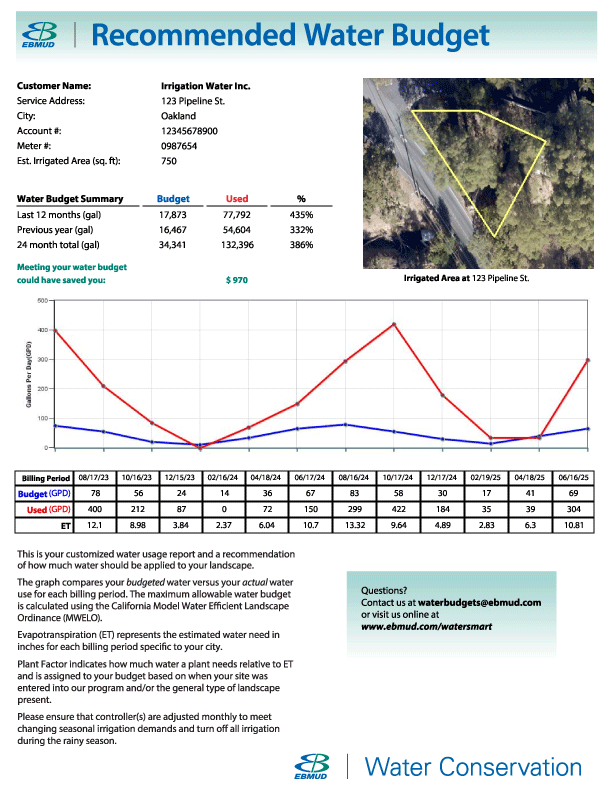
Water budgets are tools that help commercial, large-landscape customers track the efficiency of their landscape water use. EBMUD water budget program is free to customers with meters that serve irrigation exclusively.
Replace lawn with water-wise plants adapted to our climate and you may be eligible to receive an EBMUD rebate.
View our Sustainable Landscape Map to find beautiful, water-wise and accessible community gardens throughout our region.
Check out these Lawn to Garden Calculators to find out how many gallons of water you can save annually and estimatd payback by converting your lawn to a low water use garden.
Visit WaterSmart Gardener for tools and resources to help you create a water-efficient landscape.
Detailed information on water-saving technologies are available for commercial, industrial, and institutional customers, both for new designs and retrofits.