Project Update: EBMUD's contractor is scheduled to install temporary heavy-duty sound walls at the Peach Street cul-de-sac staging area from November 9 through November 28, 2026. Construction activities are planned for Veterans Day, November 11. No work is scheduled for November 26 or 27 in observance of Thanksgiving. During this period, you may notice increased noise, dust, and construction activity in your neighborhood. Crews will take measures to minimize disruptions, and we appreciate your patience and understanding.
Overview
The East Bay Municipal Utility District (EBMUD) is replacing the existing water transmission pipeline between Alameda and Bay Farm Island to improve the reliability and seismic resilience of the water system.
The existing pipeline was installed in 1983 and is being upgraded to improve seismic reliability. The project will help maintain reliable water service to Alameda, which receives its water from storage reservoirs in Oakland.
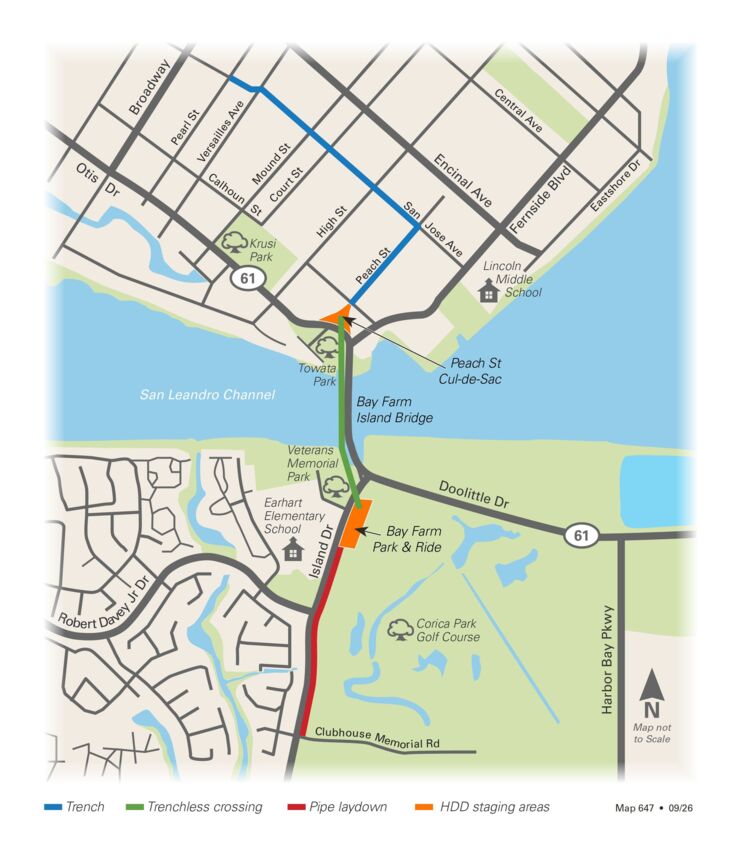
The San Leandro Channel Crossing (SLCC) Pipeline Project will install approximately 2,100 feet of 30-inch-diameter pipe about 100 feet beneath the channel using Horizontal Directional Drilling (HDD), a trenchless construction method. New steel pipe will also be installed using open-trench construction to connect the new crossing to Alameda's water transmission system.
Important Construction Information: This project involves multiple phases of construction with varying impacts to nearby residents, businesses, commuters, pedestrians, and bicyclists. Please review the information below for details about construction activities, work hours, periods of higher noise, nighttime work, traffic and access impacts, and the temporary Park & Ride closure.
You can watch the September 23, 2026 community webinar below or on the EBMUD YouTube Channel at https://youtu.be/NdTtI-y2qPM.
Project Timeline
September–October 2026
Pre-construction activities will take place at various locations on Alameda Main Island and Bay Farm Island, including potholing, field investigations and utility locating.
October–December 2026
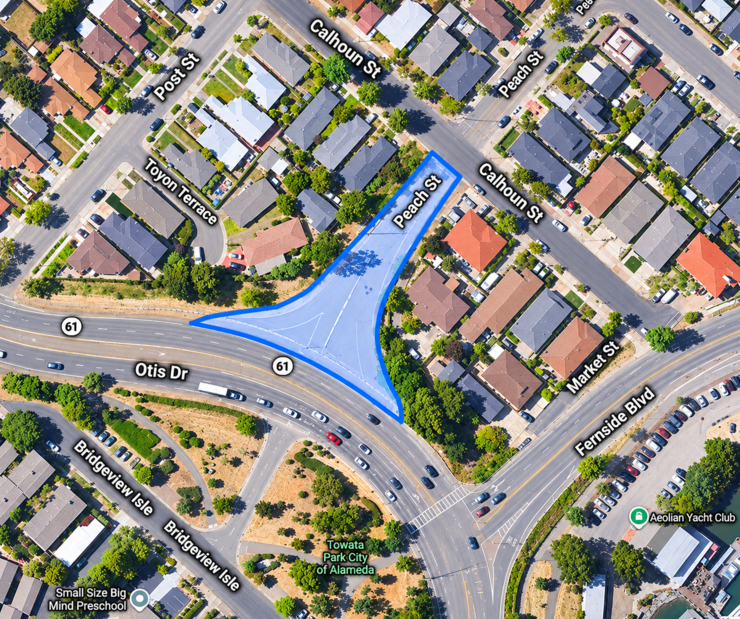
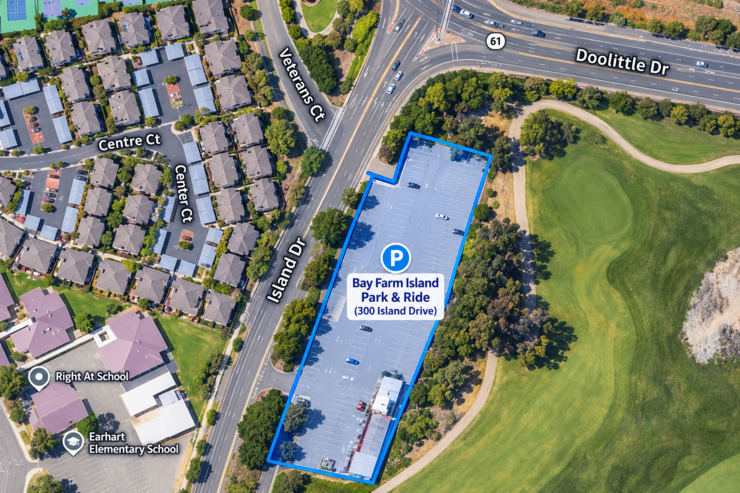
Crews will prepare the main HDD staging areas at the Peach Street cul-de-sac near Otis Drive and at the Bay Farm Park & Ride lot. These locations will serve as the entry and exit points for drilling beneath the San Leandro Channel. Activities will include sound wall construction and excavation of pits needed for HDD operations.
January–June 2027
Horizontal Directional Drilling (HDD) beneath the San Leandro Channel will take place. Work will include drilling the pilot hole, enlarging the bore, assembling the new HDPE pipeline above ground along Island Drive, and pulling the pipeline through the completed bore.
As part of the HDD work, crews will hammer large steel casing into the ground through loose, unstable soils at the HDD staging areas. This activity is expected to generate some of the highest noise levels during construction.
The pipeline pullback will require continuous work once it begins and is expected to take approximately two days, including nighttime work. EBMUD will provide advance notice to nearby residents before continuous pipeline pullback operations begin.
March 2027–January 2028
Open-trench pipeline construction will occur at several locations to connect the new pipeline to Alameda’s existing water transmission system, including:
San Jose Avenue between Pearl Street and Peach Street
Peach Street between San Jose Avenue and Otis Drive
Island Drive between Doolittle Drive and Veterans Court
Veterans Court
Open-trench construction will occur in phases and may overlap with HDD activities.
Novemeber 2027–Feburary 2028
Crews will conduct pipeline testing and complete connections to the existing water transmission system.
Feburary–May 2028
Restoration and final paving will take place in areas affected by construction.
May 2028
Project completion is anticipated.
Construction dates are approximate and subject to change.
What to Expect During Construction
Construction will occur in phases through spring 2028. The HDD process beneath the San Leandro Channel is expected to take approximately 10 weeks, with noise levels varying depending on the type of work underway.
Typical work hours will be Monday through Friday, 7 a.m. to 7 p.m. Noise levels will be monitored during construction. The approximately 2-day continuous HDD pipeline pullback will be an exception to typical work hours and will require weekend and overnight work.
Residents, businesses, commuters, pedestrians, and bicyclists near active work areas may experience temporary construction-related impacts, including:
Noise from drilling equipment, construction vehicles, excavation, and pipeline installation.
Higher noise levels during steel casing installation. Crews will use hammering equipment to install the steel casing. This is expected to be the loudest phase of HDD construction and will occur for approximately two weeks at each staging area.
Approximately two days of continuous, 24-hour work during HDD pipeline pullback, including weekend and nighttime work.
Above-ground pipeline assembly and temporary storage of the assembled HDPE pipeline along the eastern sidewalk of Island Drive.
Temporary lane closures, parking restrictions, and traffic delays near active work zones.
Increased construction vehicle traffic in the project area.
Temporary changes to pedestrian and bicycle access near construction activities.
Sound walls will be installed at the HDD staging areas, and noise and vibration levels will be monitored during construction. EBMUD will provide advance notice of major construction activities, nighttime work, and significant traffic changes whenever possible.
Park & Ride Temporary Closure
The Island Drive Park & Ride lot, located next to Grandview Pavilion at 300 Island Drive, will be temporarily closed from January 1 through approximately July 1, 2027, to accommodate construction of the San Leandro Channel Crossing (SLCC) Pipeline Project.
During the six-month closure, Park & Ride parking will be temporarily relocated to 885A Island Drive, at the Harbor Bay Landing parking lot (former CVS location). Temporary parking will be available beginning January 1, 2027.
Signs will be posted at the existing Park & Ride lot to notify commuters of the closure and direct them to the temporary parking location.
Horizontal Directional Drilling (HDD) Explained
To install the new pipeline beneath the San Leandro Channel, EBMUD will use Horizontal Directional Drilling (HDD), a trenchless construction method that allows the pipeline to be installed deep below the channel without excavating through or disturbing the waterway above.
The Peach Street cul-de-sac near Otis Drive and the Bay Farm Park & Ride area will serve as the entry and exit staging areas for drilling beneath the channel.
The HDD process involves several major steps:
1. Prepare the entry and exit areas
Crews will excavate pits and prepare equipment at the HDD staging areas on both sides of the San Leandro Channel.
2. Install steel casing
Large steel casing must be installed through the soils near the surface before drilling can continue deeper beneath the channel. Crews will use hammering equipment to drive the casing into the ground.
This is expected to be the loudest phase of HDD construction. Steel casing installation is anticipated to take approximately two weeks at each staging area. Higher-noise activities will take place Monday through Friday between 8 a.m. and 7 p.m. Noise levels will be monitored during construction.
3. Drill beneath the San Leandro Channel
Once the casing is installed, specialized drilling equipment will create a borehole approximately 100 feet beneath the San Leandro Channel. The horizontal directional drilling (HDD) process is expected to take approximately 10 weeks.
During drilling, a mixture of water and clay, known as drilling fluid, is continuously pumped into the borehole. This fluid lubricates the drill head, captures the excavated soil, and carries it back to the entry pit as a wet slurry. Because the excavated soil remains wet throughout the process, HDD drilling does not generate dust from the excavated material.
4. Assemble the new pipeline
While drilling is underway, crews will assemble the approximately 2,100-foot HDPE pipeline above ground along Island Drive. The assembled pipeline will be temporarily stored along the eastern sidewalk of Island Drive until it is ready to be installed.
5. Pull the pipeline beneath the channel
Once the borehole and pipeline are ready, crews will pull the completed HDPE pipeline through the borehole beneath the San Leandro Channel. Once pipeline pullback begins, the operation must continue without interruption until the pipeline is fully installed.
Pullback is expected to take approximately two days and will require continuous, 24-hour operations, including weekend and nighttime work. EBMUD will provide advance notice to nearby residents before this work begins.
Community Benefits
The SLCC Project will provide a second seismically resilient water transmission pipeline serving Alameda. The first was completed in 2023 beneath the Oakland Inner Harbor, connecting Oakland and northern Alameda.
Together, the two crossings will provide greater redundancy in Alameda's water transmission system, helping maintain reliable water service during emergencies, maintenance activities, and following a major earthquake. This added resilience will benefit homes, businesses, schools, and emergency services throughout Alameda and Bay Farm Island.
Frequently Asked Questions
EBMUD understands that construction dust is a concern for nearby residents, particularly those with respiratory conditions.
The contractor is required to develop and implement a Dust Control and Monitoring Plan that complies with applicable local, state, and federal regulations. Dust-control measures include spraying water, covering exposed materials, and installing dust monitors at the Peach Street staging area. EBMUD will oversee the contractor’s compliance with applicable air quality requirements.
Dust conditions will be monitored throughout construction. Regular site inspections will evaluate the effectiveness of dust-control measures, and adjustments will be made as needed based on site conditions. If monitoring indicates that dust levels approach or exceed established thresholds, the contractor must take immediate corrective action. Construction activities may be modified or stopped until the issue is resolved.
These measures are designed to protect workers and help minimize dust exposure for nearby residents.
Yes. The project includes dust monitoring and soil testing programs overseen by qualified environmental professionals.
Monitoring and testing results will be used by EBMUD and the project team to verify compliance with applicable requirements and determine whether corrective actions are necessary.
Detailed monitoring data and laboratory results are not currently scheduled for routine publication on the project webpage. However, EBMUD is evaluating options for sharing monitoring information with the public and will continue to communicate significant project updates and issues that may affect the surrounding community.
EBMUD understands residents’ concerns about construction vibration and has incorporated continuous vibration monitoring into the project.
Monitoring equipment will be installed at the construction site boundary, closer to construction activities than nearby homes. The project’s vibration limits are set well below levels associated with minor cosmetic damage to buildings, such as cracks in drywall or plaster. Vibration levels at nearby homes are therefore expected to be lower than those measured at the construction boundary.
If vibration levels approach the established limits, the contractor will be required to adjust construction methods or temporarily stop work until conditions meet project requirements.
If you believe EBMUD construction activities have caused damage to your property, please contact EBMUD Community Affairs at 510-287-0544 or construction-south@ebmud.com.
The loudest construction activity is expected to be the hammering used to install large steel casings at the drilling sites. This work is anticipated to last approximately two weeks at each location.
To reduce noise impacts on nearby residents, the contractor will install temporary heavy-duty sound walls around the drilling and excavation areas. High-noise activities, including casing hammering and drilling, will be limited to approved daytime work hours, generally between 8 a.m. and 7 p.m.
While construction noise cannot be eliminated, EBMUD will oversee the contractor’s compliance with applicable noise requirements and approved work hours.
Most construction activities, including drilling and steel casing hammering, will take place during daytime hours. No nighttime drilling is planned.
The exception is the installation of the new pipeline beneath the San Leandro Channel. Once pipeline pullback begins, the operation must continue without interruption until the pipe is fully installed. This activity is expected to require approximately two days of continuous, 24-hour work.
Temporary sound walls will remain in place to help reduce noise impacts. Construction lighting will be necessary for safety during nighttime operations and, where feasible, will be directed away from nearby homes.
EBMUD will notify nearby residents in advance of the continuous pipeline pullback operation.
EBMUD recognizes that construction may affect school commutes, particularly for students and families traveling between Bay Farm Island and Alameda Main Island.
During a portion of the project in the first half of 2027, Island Drive will be temporarily reduced to one northbound lane, Monday through Friday, from 9 a.m. to 3 p.m. These hours are intended to avoid the morning school commute and reduce traffic disruptions. We also recognize that Alameda schools have early dismissal on Wednesdays at approximately 2 p.m. and will coordinate with the project team to monitor traffic conditions and manage impacts as needed.
Separately, pipeline installation along San Jose Avenue will involve temporary, rolling work zones. San Jose Avenue is an important walking and bicycling route for students attending Lincoln Middle School. Traffic controls and temporary detours will be implemented as needed to provide safe passage around active construction areas.
These traffic impacts will be temporary and will not continue throughout the entire project. EBMUD will provide updates as construction progresses so students and families can plan their travel accordingly.
Protecting birds and shoreline habitat is part of the project’s environmental permitting and construction planning. EBMUD completed a Biological Assessment as part of the U.S. Army Corps of Engineers permitting process, which included coordination with the U.S. Fish and Wildlife Service.
During nesting season, a qualified biologist will survey applicable work areas before ground-disturbing activities begin. If active nests are found, appropriate protective buffers, monitoring, and other required measures will be implemented.
The project will also follow applicable environmental permit requirements and safeguards during construction.